

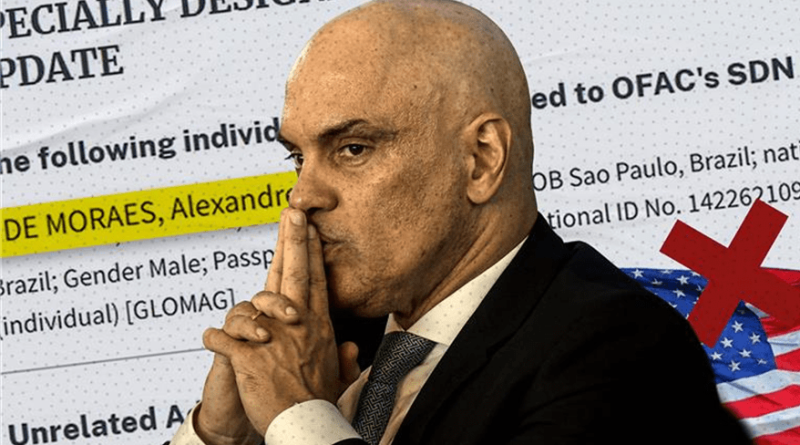
EUA anunciam sanções a Alexandre de Moraes pela lei Magnitsky
Norma norte-americana mira abusos de direitos humanos, com efeitos reputacionais e patrimoniais.
O governo dos Estados Unidos anunciou nesta quarta-feira, 30, que o ministro Alexandre de Moraes, do STF, receberá sanções da lei Magnitsky. A decisão foi publicada pelo Escritório de Controle de Ativos Estrangeiros do Tesouro norte-americano.
Anúncio ocorre às vésperas da taxação anunciada pelo presidente norte-americano Donald Trump contra o Brasil, que deve acontecer a partir da sexta-feira, 1º.
Vistos revogados
No último dia 18, o secretário de Estado dos EUA, Marco Rubio, havia anunciado a revogação de vistos dos EUA de ministros do STF e seus parentes, citando Moraes nominalmente.
Para justificar a medida, o secretário americano citou o processo que corre no STF contra o ex-presidente Jair Bolsonaro, que é tornou réu por tentativa de golpe de Estado após perder as eleições para Lula em 2022.
O que é a Lei Magnitsky?
Criada em 2012, a lei Magnitsky foi originalmente pensada para punir autoridades russas envolvidas na morte do advogado Sergei Magnitsky, que havia denunciado um esquema bilionário de fraude fiscal. Com o tempo, a legislação foi expandida, passando a ter escopo global, e hoje é considerada uma das principais ferramentas de sanção unilateral dos EUA contra envolvidos em violações de direitos humanos ou corrupção sistêmica.
As medidas previstas incluem bloqueio de bens sob jurisdição americana, proibição de entrada nos EUA e restrições a transações com pessoas ou empresas norte-americanas. A designação é feita pelo Departamento do Tesouro (OFAC), sem necessidade de decisão judicial, com base em informações provenientes de parlamentares, ONGs e governos estrangeiros.
Veja a íntegra da nota publicada pelo governo dos Estados Unidos:
“Treasury Sanctions Alexandre de Moraes
July 30, 2025
WASHINGTON – Today, the U.S. Department of the Treasury’s Office of Foreign Assets Control (OFAC) is sanctioning Brazilian Supreme Federal Court (STF) justice Alexandre de Moraes (de Moraes), who has used his position to authorize arbitrary pre-trial detentions and suppress freedom of expression.
“Alexandre de Moraes has taken it upon himself to be judge and jury in an unlawful witch hunt against U.S. and Brazilian citizens and companies,” said Secretary of the Treasury Scott Bessent. “De Moraes is responsible for an oppressive campaign of censorship, arbitrary detentions that violate human rights, and politicized prosecutions-including against former President Jair Bolsonaro. Today’s action makes clear that Treasury will continue to hold accountable those who threaten U.S. interests and the freedoms of our citizens.”
Today’s action is being taken pursuant to Executive Order (E.O.) 13818, which builds upon and implements the Global Magnitsky Human Rights Accountability Act and targets perpetrators of serious human rights abuse around the world. Today’s action follows the U.S. Department of State’s revocation of de Moraes’s visa and those of his immediate family members on July 18, 2025, for their complicity in aiding and abetting de Moraes’ unlawful censorship campaign against U.S. persons on U.S. soil.
DE MORAES’ ABUSIVE JUDICIAL OVERREACH
De Moraes was appointed to the STF in 2017. Since that time, de Moraes has become one of Brazil’s most powerful individuals, wielding immense authority through his oversight of expansive STF investigations. De Moraes has investigated, prosecuted, and suppressed those who have engaged in speech that is protected under the U.S. Constitution, repeatedly subjecting victims to long preventive detentions without bringing charges. Through his actions as an STF justice, de Moraes has undermined Brazilians’ and Americans’ rights to freedom of expression. In one notable instance, de Moraes arbitrarily detained a journalist for over a year in retaliation for exercising freedom of expression.
De Moraes has targeted opposition politicians, including former President Jair Bolsonaro; journalists; newspapers; U.S. social media platforms; and other U.S. and international companies. U.S.-based journalists and U.S. citizens have not been spared from de Moraes’ extraterritorial overreach. De Moraes has imposed preventive detention on and issued a series of preventive arrest warrants against journalists and social media users, some of whom are based in the United States. He has also directly issued orders to U.S. social media companies to block or remove hundreds of accounts, often those of his critics and other critics of the Brazilian government, including U.S. persons. De Moraes has frozen assets and revoked passports of his critics; banned accounts from social media; and directed Brazil’s federal police to raid his critics’ homes, seize their belongings, and ensure their preventive detention.
De Moraes is being sanctioned pursuant to E.O. 13818 for being a foreign person who is responsible for or complicit in, or has directly or indirectly engaged in, serious human rights abuse.
GLOBAL MAGNITSKY
Building upon the Global Magnitsky Human Rights Accountability Act, E.O. 13818 was issued on December 20, 2017, in recognition that the prevalence of human rights abuse and corruption that have their source, in whole or in substantial part, outside the United States, had reached such scope and gravity as to threaten the stability of international political and economic systems. Human rights abuse and corruption undermine the values that form an essential foundation of stable, secure, and functioning societies; have devastating impacts on individuals; weaken democratic institutions; degrade the rule of law; perpetuate violent conflicts; facilitate the activities of dangerous persons; and undermine economic markets. The United States seeks to impose tangible and significant consequences on those who commit serious human rights abuses or engage in corruption, as well as to protect the financial system of the United States from abuse by these same persons.
SANCTIONS IMPLICATIONS
As a result of today’s action, all property and interests in property of the designated or blocked person described above that are in the United States or in the possession or control of U.S. persons are blocked and must be reported to OFAC. In addition, any entities that are owned, directly or indirectly, individually or in the aggregate, 50 percent or more by one or more blocked persons are also blocked. Unless authorized by a general or specific license issued by OFAC, or exempt, OFAC’s regulations generally prohibit all transactions by U.S. persons or within (or transiting) the United States that involve any property or interests in property of blocked persons.
Violations of U.S. sanctions may result in the imposition of civil or criminal penalties on U.S. and foreign persons. OFAC may impose civil penalties for sanctions violations on a strict liability basis. OFAC’s Economic Sanctions Enforcement Guidelines provide more information regarding OFAC’s enforcement of U.S. economic sanctions. In addition, financial institutions and other persons may risk exposure to sanctions for engaging in certain transactions or activities involving designated or otherwise blocked persons. The prohibitions include the making of any contribution or provision of funds, goods, or services by, to, or for the benefit of any designated or blocked person, or the receipt of any contribution or provision of funds, goods, or services from any such person.
The power and integrity of OFAC sanctions derive not only from OFAC’s ability to designate and add persons to the Specially Designated Nationals and Blocked Persons List (SDN List), but also from its willingness to remove persons from the SDN List consistent with the law. The ultimate goal of sanctions is not to punish, but to bring about a positive change in behavior. For information concerning the process for seeking removal from an OFAC list, including the SDN List, or to submit a request, please refer to OFAC’s guidance on Filing a Petition for Removal from an OFAC List.”
Com informações do MG


